Product Description
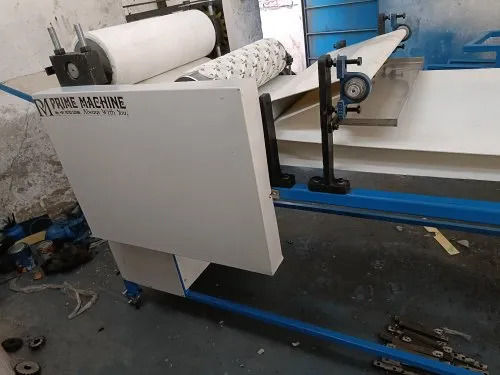
Fully Automatic Papad Machine
We are recognized in the market as a well known manufacturer and supplier, engaged in offering Fully Automatic Papad Making Machine to our customers. Our provided professional team manufactures this machine using industry standard raw materials sourced from the authorized vendors. Our machine is long lasting, rust resistant and easy to use. Due to these features, this Fully Automatic Papad Making Machine is widely used in restaurants and hotels. We provide this machine in custom made specifications according to our customers needs.
Advanced Automation for Streamlined ProductionThis fully automatic papad machine transforms traditional papad making by incorporating computerized controls, centralized lubrication, and an automatic feeder. Its floor-mounted setup saves space, while its robust components and variable speed modes ensure consistent quality with minimal intervention. The integration of a PLC control panel centralizes all operational commands, allowing a single operator to efficiently manage the complete process.
Precision Engineering for Versatile Papad MakingDesigned for flexibility, the machine accommodates diverse raw materials like urad dal, moong dal, or rice flour, and supports multiple shapes-round, oval, or custom. Thickness and diameter can be finely adjusted, making it suitable for various recipe requirements. The die-changing process takes less than 10 minutes, expanding your product range without significant downtime.
User-Centric Maintenance and Safety FeaturesMaintenance is straightforward thanks to its modular, easy-to-clean parts and centralized automated lubrication. Safety is integral, featuring an emergency stop mechanism and overload protection. With a corrosion-resistant, polished stainless steel body, the machine is both durable and hygienic, maintaining compliance with food safety standards in commercial environments.
FAQ's of Fully Automatic Papad Machine:
Q: How does the fully automatic papad machine improve production efficiency?
A: The machine streamlines the entire papad production process using advanced PLC controls, automated feeders, and centralized lubrication. This allows a single operator to achieve continuous, high-output production ranging from 40 to 150 kg/hr, with consistent quality and minimal downtime for adjustments or maintenance.
Q: What types and sizes of papad can be produced with this machine?
A: This machine is compatible with all types of papads made from urad dal, moong dal, rice flour, or spices. It can produce round, oval, and custom shapes with diameters between 3" and 8", and thicknesses adjustable from 0.3 mm to 2.5 mm.
Q: When is it necessary to change the die, and how long does it take?
A: A die change is required when switching between papad sizes or shapes. The user-friendly modular design allows the die to be changed in less than 10 minutes, minimizing production delays and supporting a diverse product portfolio.
Q: Where is this machine best suited for installation?
A: This floor-mounted, industrial-grade papad machine is ideal for commercial or large-scale food processing units such as manufacturing plants, exporters, or catering facilities in India and abroad. Its compact dimensions (approx. 10 x 2 x 5 ft) allow easy integration into production lines.
Q: What is the cleaning and maintenance process for this machine?
A: Maintenance is simplified with modular, easy-to-clean parts and a centralized automated lubrication system. The smooth, polished stainless steel surface is corrosion-resistant, supporting frequent cleaning to uphold hygiene standards.
Q: How does the machine ensure operator safety during use?
A: Safety features include an emergency stop button and overload protection, which immediately halt the machine in case of malfunction or excess load, protecting both operator and equipment during continuous operation.
Q: What benefits does this machine offer compared to semi-automatic or manual papad making?
A: This fully automatic model delivers higher productivity, energy efficiency, uniform product shaping, and requires less labor compared to manual or semi-automatic alternatives. Its advanced automation reduces human error, ensures consistent quality, and lowers overall production costs for commercial enterprises.


 Send Inquiry






 Send Inquiry
 Send SMS
 Call Me Free